
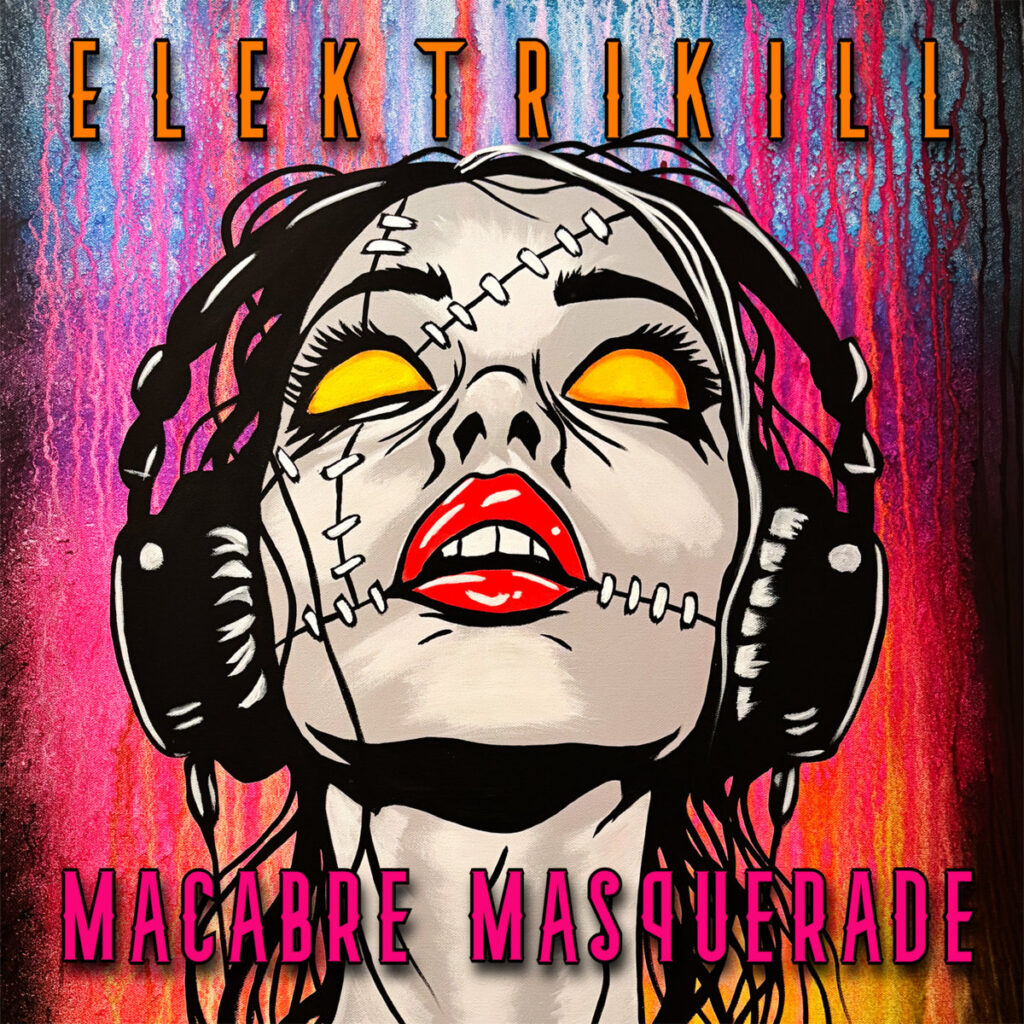
Elektrikill invites listeners into a celebration where the witching hour never ends, transforming Halloween horror into a relentless collision of industrial rhythms, dark electronics, monsters, and macabre humor.
The Macabre Masquerade Begins at Midnight
New Jersey industrial project Elektrikill, led by musician and producer Steve Vil, has officially released Macabre Masquerade through Evol Music Group. Released September 1, 2026, the 13-track Halloween album is constructed as a continuous celebration of everything lurking in the dark.
The album combines brand-new material with reworked Elektrikill songs, terrifying interludes, and remixes from Kill Vector, Kontrol Phreak, and SPKTR. Rather than simply assembling a collection of horror-themed tracks, Elektrikill sequences the album like one long infernal party—complete with vampires, demons, werewolves, parasites, restless ghosts, and enough industrial machinery to wake the dead.
Throughout Macabre Masquerade, Elektrikill moves between pounding EBM, darkwave atmosphere, industrial-rock aggression, electronic dance rhythms, and cinematic horror. The result is sinister without becoming joyless, balancing menace with enough twisted humor and dancefloor energy to keep the party moving long after the cemetery gates have closed.
Purchase CD/Download here: Macabre Masquerade | Elektrikill
Purchase Vinyl LP here: Macabre Masquerade – elasticStage
Reviews For “Macabre Masquerade”:
Chain D.L.K.:
Halloween is generally the one night of the year when people willingly dress as monsters, although the rest of the calendar offers ample evidence that the distinction between costume and character is becoming increasingly academic. Elektrikill’s “Macabre Masquerade” takes this observation rather seriously, then proceeds to have a thoroughly unhealthy amount of fun with it. The second full-length album released by Steve Vil’s New Jersey project in 2026 is a thirteen-track gathering of vampires, parasites, demons, digital phantoms and assorted human malfunctions, held together by pounding electronic rhythms, industrial abrasion and a decidedly crooked sense of humour. It is a record that knows its horror references, enjoys its own theatrical excesses, and occasionally seems to suspect that the most frightening creature in the room might be the person holding the smartphone.
The album is conceived as a continuous Halloween celebration, but its construction is more interesting than a simple parade of seasonal curiosities. Alongside new material, Vil revisits earlier Elektrikill compositions, gives them new treatments and invites Kill Vector, Kontrol Phreak and SPKTR to contribute remixes. DarkHeart Syndicate also joins the project on “Digital Ghosts”. The result is a mixture of original tracks, alternate versions, collaborations and short interludes, arranged to maintain the impression of one extended nocturnal event. The approach has its risks: thirteen tracks built around a common horror aesthetic could easily become a rather exhausting exercise in graveyard decoration. Yet the changes in rhythm, texture and attitude give the album enough variation to keep its monsters from looking like identical extras in a low-budget zombie film.
The opening title track is a short spoken introduction to the proceedings, establishing the album’s deliberately exaggerated atmosphere. Its references to supernatural creatures, corrupted machines and questionable refreshments set the tone, while the closing suggestion that eternity is a very long time provides a useful reminder that even the undead might eventually become bored. “Vampire Blond (Revamped)” follows with a more recognisable song structure, combining dark electronic propulsion with a camp horror narrative. The Russian setting, sinister seductress and undead witch are handled with a knowing theatricality that owes as much to the tradition of gothic pulp as to industrial music. The track’s revised treatment also makes sense within the album’s broader logic: Vil is not merely recycling older material, but dressing it for a different occasion.
The first substantial shift arrives with “Digital Ghosts”, a collaboration with DarkHeart Syndicate. Here the monsters are no longer supernatural, but technological and social. The lyrics address surveillance, data extraction, manufactured outrage, algorithmic distraction and the gradual surrender of individual agency to digital systems. It is the album’s most overtly contemporary subject, and arguably its most convincing conceptual moment. The idea of electronic ghosts haunting the machinery of everyday life is hardly new, but it acquires a suitably uncomfortable dimension when placed alongside the record’s more traditional horror imagery. The track suggests that the supernatural has been made almost redundant by systems capable of recording, measuring and monetising practically every human impulse. Dracula wanted your blood; the modern vampire prefers your behavioural data, and has a much better customer-retention strategy.
“I See Demons (Michael Myers Murder Mix)” turns the focus inward. Its horror is psychological, built around the disturbing possibility that evil is not always something encountered in another person. The repeated uncertainty between what is perceived and what is desired gives the track a more paranoid character, while the references to a smiling public face concealing something murderous play effectively with the album’s interest in masks and deception. The Michael Myers designation places it firmly within the slasher-film universe, but the underlying subject is less about a masked killer than about the capacity for self-deception. The monster, as usual, has an inconvenient habit of looking familiar.
Kontrol Phreak’s “Parasite (Darkest Fear Mix)” brings a more direct club-oriented energy. Its repetitive vocal structure reinforces the idea of an intrusive presence taking up residence in somebody else’s mind, turning psychological dependency into something almost physically invasive. The remix treatment gives the track a more pronounced electronic insistence, and its relatively straightforward construction makes it one of the album’s more immediate moments. “I Used To Be Human (Body Horror Mix)” is considerably less playful in its implications. The repeated loss of empathy, innocence and conscience is framed as a transformation into something monstrous, with the body-horror reference extending beyond physical mutation towards a more disturbing alteration of character. It is one of the record’s bleakest ideas: the creature is not born evil, but manufactured through damage, exploitation and betrayal. The distinction is important, even if the resulting monster is unlikely to receive an invitation to the neighbourhood barbecue.
Kill Vector’s contribution to “Ravenous (Rave Noose Mix)” shifts the emphasis towards appetite, instinct and predation. The title is a particularly effective piece of wordplay, suggesting both the compulsive energy of rave culture and the more sinister implications of being caught in an endless cycle of desire. The remix gives the track a strong rhythmic identity, while the lyrics abandon the comforting fiction that humanity has somehow escaped its animal origins. The distinction between survival and cruelty becomes increasingly difficult to maintain. It is a suitably carnivorous moment, although one suspects that the refreshments at this particular party should be inspected rather carefully.
“The Scream (Screamix)” returns to the album’s technological unease, with the hum of electrical systems, photographic records and the unreliability of perception providing the basis for another confrontation with the self. Its central image is that of an internal voice that remains unheard until it becomes impossible to ignore. The track’s expanded treatment gives the material room to develop beyond a simple horror reference, while the title also nods towards the cinematic language that informs much of the record. The subsequent “Drugs & Candy (Trick Mixxx by SPKTR)” is almost absurdly concise, reducing its subject to a deliberately provocative collision between childhood treats and chemical temptation. It is the kind of joke that might make a health-and-safety officer reach for the emergency exit, but its brevity works in its favour.
“You Are The Love Of My Death” brings a more explicitly romantic form of morbidity into the picture. Its imagery of lovers bound together beyond the grave is melodramatic by design, but there is something rather appealing about the album’s refusal to separate affection from danger. Here love is not a reassuring antidote to darkness; it is another pact whose consequences may be difficult to escape. “Monster” then returns to the central question of responsibility, suggesting that the creature’s violence may be a response to the cruelty of the world that created it. The narrative moves from persecution to revenge, raising the familiar horror-film question of who, exactly, deserves to be called monstrous. The answer is not particularly comforting.
The two closing pieces, “Drugs & Candy (Treat Mix)” and “Hellhole (Unending Torment Mix)”, function as brief, deliberately exaggerated codas. The former uses fragments of spoken material to push its dark joke into more uncomfortable territory, while the latter reduces the finale to a handful of apocalyptic declarations. Neither is intended as a fully developed composition; they are closer to the last scraps of noise and conversation after the main event has become thoroughly unmanageable. Ending with a short descent into infernal absurdity feels entirely appropriate. There is no attempt to restore order, and frankly, after this many monsters, a tidy conclusion would have seemed suspicious.
The record’s principal limitation is also connected to its greatest strength. Its imagery is deliberately unsubtle, and the lyrics sometimes favour blunt declarations over ambiguity. The monsters are named, the villains are identified, and the moral conclusions are rarely left entirely unresolved. Listeners looking for the psychological complexity of David Lynch or the restrained dread of a genuinely unsettling horror soundtrack may find the album rather too eager to explain its own nightmares. But subtlety is not the only available artistic virtue, and there is a certain pleasure in an album that understands the value of theatrical excess. Its humour is often broad, its references unmistakable, and its appetite for grotesque imagery seemingly limitless. Not every Halloween party needs to be an exercise in existential refinement.
What gives “Macabre Masquerade” a little more substance than its seasonal premise might suggest is the continuity between its supernatural and contemporary subjects. Vampires, demons and parasites are not merely decorative characters; they become metaphors for exploitation, addiction, surveillance and the corruption of human relationships. The album’s most effective moments occur when the distinction between these categories begins to disappear. Its monsters may have fangs, claws and supernatural appetites, but the most recognisable horrors are often those that require no special effects at all.
In the end, “Macabre Masquerade” is a lively, unapologetically theatrical industrial album that understands the value of a good fright and an even better punchline. It does not attempt to reinvent dark electronic music, nor does it need to. Instead, Steve Vil assembles a suitably unruly celebration from his own catalogue, new material and outside contributions, giving familiar themes a fresh set of masks. The party may be eternal, but at least the soundtrack knows when to change the record. And if something starts scratching at the door after the final track, it is probably best not to check whether it has brought candy.
Bog Stenchmare:
The first thing we need to say is that ELEKTRIKILL experiments with and utilizes many approaches in a wide-ranging musical palette. Bog has tried to share this and what he heard, which made for an interesting breakdown. There are high-energy stomps and booms; mid-paced tracks where you need to pull your boots up a little so you can check they are still attached to your feet for bass-dancing; and slow, dark, sinister, horror-fueled tracks that carry an energy about them. But also, for those who appreciate slow, moody, ballad-oriented goth feels, those elements are there, too.
In Track 10, “You Are The Love of My Death,” Bog could even hear the swampy, death-blues vibe shine through. So, although the album is horror-themed, it has drawn from multiple backgrounds.
Hard labor has gone into this album, and it is not just a casual, “Okay, that will do, yep, okay, next”. No, there is much more care and time invested here.
Bog enjoyed Macabre Masquerade. Okay, there were a few tracks he didn’t quite vibe with, but there weren’t many, nor did he hate them.
This is a fun, thrilling ride of stomps, bass, sinister lines, memorable choruses, and just solid music with different elements to present dark beats within a gritty, industrial world.

